Andrology
Andrology is a central component of fertility treatment: with precise diagnostic and therapeutic options for men, we identify the causes of unwanted childlessness and lay the foundation for a successful pregnancy.
Andrology is a central component of fertility treatment: with precise diagnostic and therapeutic options for men, we identify the causes of unwanted childlessness and lay the foundation for a successful pregnancy.

You would like to become a father and have decided to undergo fertility treatment? In fact, research shows that the causes of an unfulfilled desire to have children are shared equally by men and women (40% each). In one fifth of couples, both partners have findings that can make it difficult to get pregnant. Andrology, with its precise diagnostic and therapeutic options, is accordingly an important component of fertility treatment.
A laboratory that focuses on sperm
The sperm quality check takes place in our andrological laboratory. Here we look specifically for possible causes of the unfulfilled desire to have a child, clarify important questions in the context of the treatment and prepare for artificial insemination. Several rooms with a pleasant ambience are available for the delivery of the necessary sperm sample.
What can a spermogram do?
In particular, the spermiogram provides information about the number, shape and motility of the sperm. First, we examine the aspects that can be seen with the naked eye, macroscopically. These include, for example, the volume, consistency and pH value. This is followed by an examination under the microscope. Here we can see how mobile the individual sperm are, what shape they are and how many there are.
If necessary, we examine further parameters of the sperm within the context of immunological and bacteriological examinations and determine their physical, morphological, biochemical and histochemical properties. For special questions we use sperm function tests to determine, for example, how the sperm behave in the cervical mucus, how their binding behaviour is or how vital they are.
The extraction of sperm from the testicular tissue and the cryopreservation of sperm are also part of the tasks of andrology. The sperm processing required for this - just as with sperm use in treatment (IVF, ICSI, TESE, etc.) - is of course performed under cleanroom conditions.
In order to consistently ensure the high quality of our semen analyses, we constantly have them checked by external interlaboratory tests.
1.What is DNA fragmentation?
The genetic information in the sperm head can be damaged by various factors, causing breaks in the DNA – a process known as DNA fragmentation. This can significantly impair fertility.
2.Effects on fertility
A high DNA fragmentation index (DFI) reduces the chances of successful natural conception and assisted reproduction (IUI, IVF). Values above 25% lower the pregnancy rate, and IVF results deteriorate significantly above 50%. An estimated 10-15% of infertile men have increased DNA fragmentation – often despite normal sperm count and motility.
3.Causes of increased DNA fragmentation
Common triggers are:
4.Testing in our practice
We determine the DFI using the SCD test (Halosperm D2). A fresh sperm sample is stained and analysed under a microscope.
5.When is the test useful?
The examination is recommended for:
6.Opportunities for improvement
7.Expenses
The costs are not covered by health insurance, but can be claimed for tax purposes.
8.Any questions?
Your practice team will be happy to advise you!
There are couples whose unwanted infertility cannot be explained by standard diagnostics, particularly when the standard parameters (quantity/motility/appearance) of the semen analysis do not provide an explanation.
This is where differentiated functional diagnostics come into play. One new tool is testing the function of the CatSper channel.
1.What is the CatSper channel?
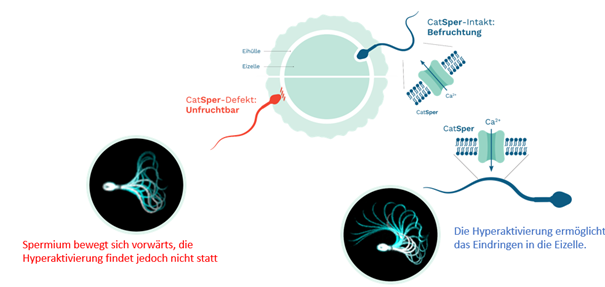
The CatSper channel (cation channel of sperm) is located in the main part of the sperm tail and is responsible for the so-called hyperactivation of the sperm – a special form of movement that is necessary for penetration into the egg cell. This activation is triggered by the hormone progesterone, among other things. A defect in the CatSper channel can therefore be a cause of male infertility, even if a sperm analysis appears normal.
2.Genetic defects of the CatSper channel
CatSper channel malfunctions are often genetic in origin, primarily due to mutations in the CATSPER2 gene. Other CATSPER genes may also be affected. Research is currently being conducted to determine whether environmental factors or medications influence function. It is estimated that CatSper dysfunction affects approximately 1% of men who are unable to conceive.
3.The CatSper test in our practice
With the certified ‘CATflux’ test, we offer testing for CatSper defects. This requires a fresh sperm sample, which can be provided at the clinic or at home. The test can also be performed in parallel with a semen analysis or DNA fragmentation analysis.
4.Who should take the test?
As CatSper defects are not yet covered by current guidelines, the test is primarily aimed at men who are unable to conceive with their partners, who have not yet become pregnant. The test is not necessary in cases of previous pregnancies (including miscarriages). It can also be considered for men who are actively planning to start a family.
5.Advantages of the test
6.Cost coverage
The cost of the test is not covered by health insurance, but can be claimed for tax purposes.
7.Do you have any questions?
Your practice team is always at your service!
Book a first consultationRegister for the information evening