Social Freezing
Social freezing allows you to consciously plan the timing of a possible pregnancy and preserve the quality of your eggs for the future.
Social freezing allows you to consciously plan the timing of a possible pregnancy and preserve the quality of your eggs for the future.

With social freezing – the freezing of oocytes – you can deliberately postpone the time of a possible pregnancy to a later date and significantly extend your reproductive life phase. Because with increasing age, not only the number but also the quality of the oocytes decreases – and with it the probability of becoming pregnant. Freezing stops the ageing process of the oocytes so that they can be fertilised at the desired time in their original quality.
Other reasons for social freezing may include primary ovarian failure (POF) or disease-related impairment of ovarian reserve (ovarian endometriosis). The same applies to the threat to fertility posed by a pending cancer treatment. In such cases, patients have healthy oocytes frozen as a safeguard in order to be prepared for the event that it is difficult or impossible for them to become pregnant after the treatment.
The quality assurance of our cryopreservation is carried out in accordance with the guidelines of FertiPROTEKT, an association of centres dedicated to fertility preservation. The focus of the work is on fertility protection counselling prior to planned treatments (surgery, chemotherapy, radiation), which may limit the future fertility of patients as an undesirable side effect.
After ovarian hyperstimulation, unfertilised oocytes capable of fertilisation (metaphase II) are frozen. They will only be thawed, artificially inseminated (IVF/ICSI) and carried to term by you after successful embryo transfer if your professional or personal situation allows it and you and your partner have decided to have a child together. This should be done by the age of 45. This is because pregnancy after the age of 50 is associated with considerable health risks for both mother and child.
The younger you are, the greater the number of oocytes and the better the oocyte quality. This is due to the fact that with increasing age variable chromosomal aberrations or genetic changes occur in the course of oocyte maturation (maturation division). These limit the likelihood of pregnancy. So if you decide to have cryopreservation, you should not be older than 37 years. Later is still possible, but the prognosis for successful IVF/ICSI treatment is much worse.
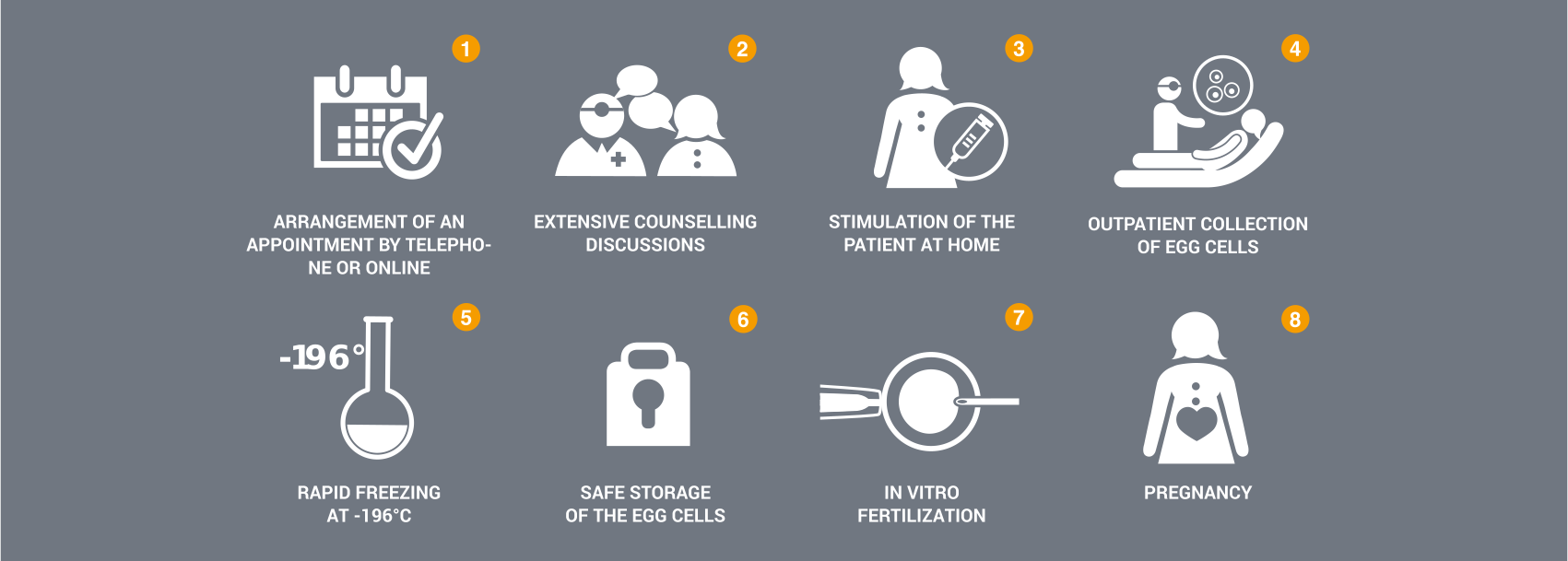
On average, ten fertilised oocytes develop into one or two vital embryos that can be transferred to the uterus. This means that cryopreserved oocytes have the same fertilisation and development capacity as fresh oocytes. And they also lead to pregnancy to the same extent, as this depends mainly on the age of the patient and the number of fertilised oocytes. Since the number of mature, fertilisable oocytes decreases with age, multiple punctures and artificial inseminations through IVF/ICSI procedures may then be necessary to achieve a reasonable cumulative birth rate (> 80%).
As you read the scenario outlined above, you may be thinking: "My God, they're exaggerating." But social freezing is not just a lifestyle issue. It can even have very serious backgrounds – for example, if you are undergoing chemotherapy and want to freeze previously unaffected oocytes and sperm. However, it is also a topic that is strongly linked to people's modern lifestyles – a topic that we approach not only with great experience in cryopreservation, but also with a great sense of responsibility. That is why we rely on individual consultation and targeted diagnostics to correctly assess your personal situation and give you the best possible recommendation.
Watch the video to learn how women can use social freezing to decide the right time for a pregnancy. Reproductive medicine specialist Dr. Julia Holtschmidt explains who can benefit from egg freezing and what options it offers.
Watch the video on ZDFheute
Book a first consultationRegister for the information evening