In-Vitro Fertilisation (IVF)
In vitro fertilisation enables the fertilisation of eggs in the laboratory and opens up new prospects for couples who are unable to conceive naturally.
In vitro fertilisation enables the fertilisation of eggs in the laboratory and opens up new prospects for couples who are unable to conceive naturally.

In-vitro fertilisation is fertilisation in a test tube (in-vitro = in a glass). For this purpose, oocytes capable of being fertilised are removed from the woman, placed in a nutrient solution in the laboratory and fertilised with the partner's sperm cells. We transfer the fertilised oocytes or embryos back into the uterine cavity.
Since the first "test-tube baby" in 1978, this type of artificial insemination has been constantly developed and refined. This has significantly increased the chances of success for pregnancy.
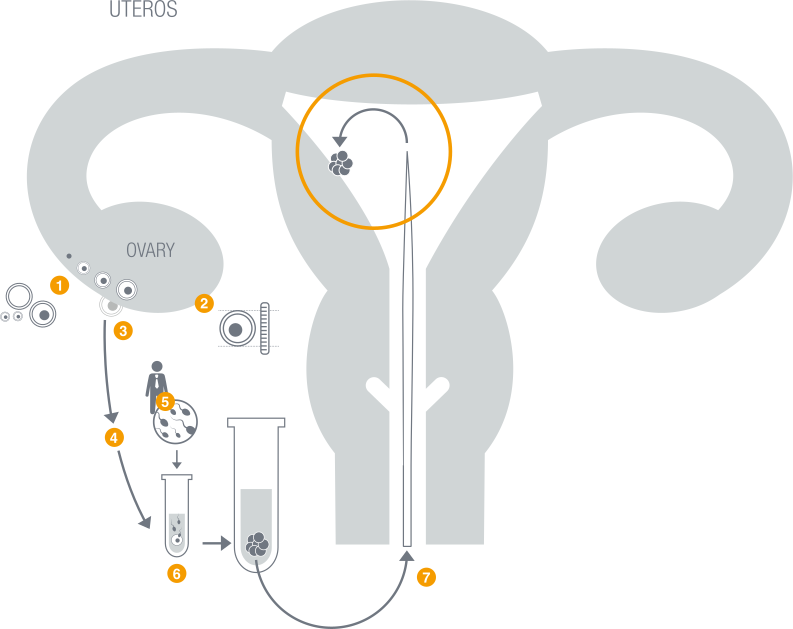
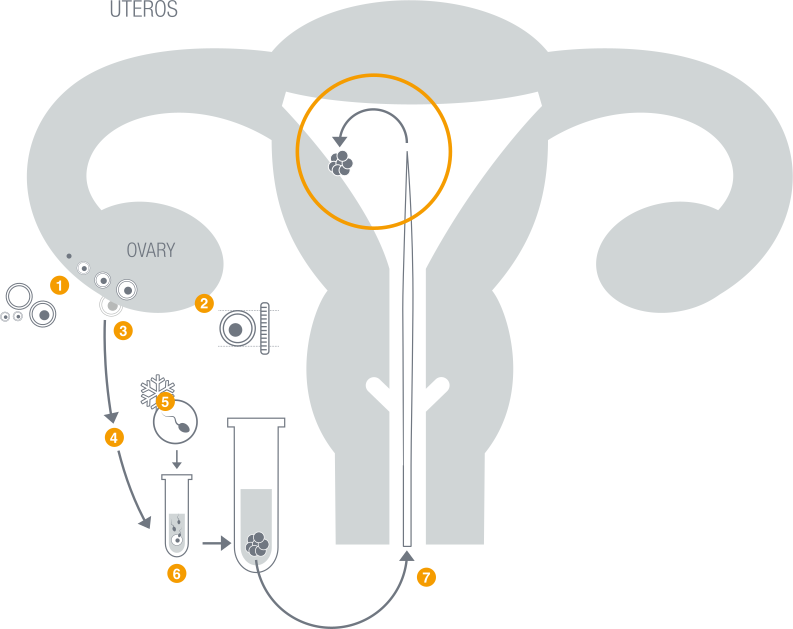
1.Promotion of oocyte maturation
Retrieval and fertilisation of multiple oocytes
Through controlled hormonal hyperstimulation, we increase the chances of retrieving multiple oocytes to successfully fertilise them and transfer one to three embryos into the uterus. Hormonal stimulation with genetically engineered FSH or HMG has proven successful. To prevent premature ovulation, FSH or HMG stimulation is combined with a GnRH agonist or antagonist.
2.Control of oocyte maturation
By ultrasound and blood test
During the stimulation treatment we check the growing follicles by ultrasound. In parallel, we measure the hormone estradiol (E2) in the blood, possibly also LH and progesterone. In this way, we determine the most favourable time for obtaining mature oocytes capable of fertilisation.
3.Triggering ovulation
Timely oocyte retrieval
When the most appropriate time for oocyte retrieval has arrived, we induce ovulation by injecting hCG so that the oocytes can be retrieved from the follicle after about 36 hours. 40 hours later ovulation would occur, so the oocytes would be lost.
4.Oocyte Collection
Outpatient procedure under anaesthesia
The puncture of the follicle for oocyte collection is performed from the vagina using ultrasound. A general anaesthetic is not absolutely necessary, but makes the procedure much more comfortable. In addition, sufficient oocytes can then be obtained even under difficult puncture conditions. If there are no complications, you can go home the same day.
5.Sperm extraction
Fast and germ-free to the laboratory
After the oocyte collection, the sperm must be collected within four hours. This can also be done at home if it is brought to our laboratory immediately afterwards. There, the sperm is cleaned and concentrated using special processing methods (density gradient centrifugation).
If the sperm count is particularly limited, other processing methods can be used in addition to the ICSI procedure.
If there is a complete absence of sperm from the partner, e.g. as a result of illness, surgery or radiotherapy, in-vitro fertilisation can also be performed using donor sperm. We will be happy to advise you about this possibility.
6.Artificial Insemination of the Oocytes
Union of sperm and oocytes
After two to six hours, the prepared motile sperm are added to the oocytes in the culture fluid. Conventional in-vitro fertilisation requires 250,000 motile sperm per oocyte. In most cases, the oocyte and sperm cells remain in the warming cabinet at 37° C for about 24 hours. Subsequently, it is checked whether sperm have penetrated the oocyte and whether fertilisation has taken place (impregnation).
Maturation in the incubator
We select two to three impregnated oocytes and cultivate them for one to two days in the incubator. Excess impregnated oocytes can be frozen and used at a later date. During incubation in the warming cabinet, the fertilised oocytes divide. We transfer them into the uterus as four- or eight-celled embryos.
The fertilised oocytes develop into embryos through cell division:
Falling behind in this developmental dynamic marks a possible defect in the embryo with the inability to develop further and implant. Only about 30% of the pronuclear stages reach the blastocyst stage.
7.Retransfer to the Uterus
For the transfer back into the uterus, we aspirate a selected blastocyst using a thin catheter and insert it into the uterus. The transfer is monitored via ultrasound from the abdominal wall and is a painless procedure. To achieve good pregnancy chances, the transfer of a blastocyst is performed on day 5 of embryonic development. In order to make the most accurate predictions possible, we use artificial intelligence (AI) to assess embryonic development in the embryoscope. This allows us to make more precise predictions about the live birth rate and the risk of early miscarriage due to developmental disorders. Even after transferring just one blastocyst, very good pregnancy rates can now be achieved, especially in young couples, while avoiding multiple pregnancies.
Opportunity: the younger the woman, the better
The chances of success depend on the individual circumstances of both partners and, in particular, the woman's age – however, the chances increase steadily with the number of treatment cycles. You can find our pregnancy rates hier.
1.The risks
Overstimulation can cause side effects - but these are treatable
Like any physical procedure, in-vitro fertilisation carries risks. The aim of hormone treatment is the maturation of several oocytes. Despite careful ultrasound and serum hormone monitoring, overstimulation may occur. The so-called overstimulation syndrome is associated with a marked enlargement of the ovaries, abdominal pain and relatively high oestrogen levels, which lead to increased vascular permeability and thereby to a raised risk of thrombosis. However, these symptoms are easily treated and disappear completely. During pre-diagnosis for IVF, patients with a high risk of hyperstimulation are identified. Overstimulation can be largely avoided by individually adapted stimulation.
2.Risk of malformation with extracorporeal fertilisation
Malformations in children cannot be ruled out in any pregnancy. The debate as to whether children conceived using IVF or ICSI have an increased risk of malformation remains unresolved to this day. However, the figures show that the slightly increased risk compared to naturally conceived children is not attributable to the methods used, but primarily to the genetic and personal circumstances of parents with fertility problems.
Percentage increases in risk may occur if the couple has additional individual characteristics such as:
3.No evidence of raised cancer risk
Time and again, fertility-enhancing drugs have been linked to a raised risk of cancer. There is no evidence for this.
1.Medication – promoting egg maturation, ovarian function and embryo implantation
Clomiphene – stimulates egg maturation
Clomiphene is mainly used in the run-up to simple treatment procedures, e.g. ovarian stimulation with or without insemination. Clomiphene leads to increased secretion of GnRH, the gonadotropin-releasing hormone, in the hypothalamus. This causes a significant increase in FSH, the follicle-stimulating hormone, in the pituitary gland, thereby stimulating egg maturation in the ovary. The preparation is taken as a tablet. In individual cases, hot flushes, sweating, dizziness and visual disturbances have been reported. However, these side effects usually subside immediately after discontinuing the medication. Depending on the dose, one or more eggs may mature, occasionally leading to twin pregnancies and, in very rare cases, triplet pregnancies.
Letrozole – stimulates egg maturation
Letrozole is an aromatase inhibitor used to treat hormone-dependent breast cancer. Letrozole is also used for ovarian stimulation in women (off-label use). It stimulates egg maturation by inhibiting oestrogen production, which leads to increased release of follicle-stimulating hormone (FSH).
Proteohormones (FSH, LH, HMG, HCG) – stimulate the ovaries
Follicle-stimulating hormone (FSH) is the most important hormone in stimulating the ovaries. It is used in all standard in vitro fertilisation protocols. In special cases, luteinising hormone (LH) may also be required. Both hormones are produced using genetic engineering. HMG is a purified hormone preparation obtained from urine which, in addition to a proportion of foreign proteins, primarily contains a defined amount of FSH. It is used as an alternative to genetically engineered FSH. HCG is the so-called pregnancy hormone, which is also available in genetically engineered and purified urine form. In the context of infertility treatment, it is used to trigger ovulation and support the luteal phase due to its similarity to LH. All proteohormones are administered as injections under the skin – usually by the patients themselves.
Progesterone – promotes embryo implantation
Progesterone is produced by the ovaries in the second half of the cycle after ovulation. It influences the formation of decidual cells in the uterine lining, which enable the embryos to implant. To ensure that there is enough progesterone in the uterus, progesterone capsules or a progesterone gel for insertion into the vagina are usually prescribed during IVF treatment after egg retrieval. It can also be administered in the form of injections. These medications are intended for use until the pregnancy test after two weeks and, if the test is positive, beyond that.
2.GnRH analogues and antagonists – help determine the day of ovulation
These substances make the cycle even easier to control. This allows ovulation to be triggered on the exact day. GnRH analogues and GnRH antagonists block the pituitary gland, thereby preventing premature ovulation.
GnRH analogues take effect after a two-week lead time.
External ovarian stimulation then begins with the administration of FSH or HMG. This lasts approximately nine to 14 days. During this time, you will continue to take GnRH analogues – as an injection or nasal spray. GnRH analogues are also used to trigger ovulation (off-label use). A single administration causes ovulation to be triggered in a controlled manner by your own pituitary gland. The hormones released in this way are only effective for a short time. This can help to reduce the risk of hyperstimulation syndrome or support the final maturation of the egg cells as a so-called double trigger. This effect can only be used in the GnRH antagonist protocol.
GnRH antagonists work immediately.
They are only used during ongoing stimulation – until ovulation is triggered. GnRH antagonists must be injected.
We will discuss together which of the two treatment methods is right for you.
1.Blastocyst transfer – identification of embryos with the best implantation potential
Embryos may be cultivated until the fifth or sixth day after egg retrieval in order to better assess their developmental potential. As this increases the chances of pregnancy, fewer embryos need to be transferred. This reduces the risk of higher-order multiple pregnancies without reducing the likelihood of pregnancy. Using time-lapse video morphokinetics (see also Embryoscope), it is now possible to continuously observe embryos during their early development.
2.Single Embryo Transfer SET – Avoiding multiple pregnancies
In addition to high pregnancy rates, reducing multiple pregnancies, especially twin pregnancies, has become an important quality criterion in recent years. The aim of treatment is to give birth to a healthy child while avoiding the risks associated with multiple pregnancies, such as premature birth. The developmental potential of an embryo on day two or three of embryonic development can only be predicted to a limited extent. Only some of these embryos develop to the blastocyst stage. To achieve high pregnancy rates, embryonic development is observed in the laboratory over 5 days in order to transfer an optimal blastocyst (single embryo transfer, SET) on day 5. By using state-of-the-art laboratory technology, in particular the Embryoscope incubator system with artificial intelligence-based assessment and selection of the embryo suitable for transfer (IDA score), SET achieves pregnancy rates equivalent to those achieved with the transfer of two blastocysts, while avoiding multiple pregnancies.
3.Embryoscope and AI
We use the latest technology to create the ideal conditions. A certified clean room air conditioning system with dust and carbon filters, regulated humidity and temperature (TÜV) ensures clean air. The Miri Benchtop Multiroom Incubator creates the best possible conditions for the cells under low oxygen content before fertilisation. The Embryoscope, in turn, ensures optimal incubation conditions after fertilisation. Our centre has been working with what was then the world's first Embryoscope since 2012, and we currently use the successor model, the Embryoscope+.
Time-lapse technology reduces the restrictions on observation time and stress on the embryos during culture. With the Embryoscopes, we enable undisturbed embryo culture, continuous image capture and an improvement in the evaluation process through more objective analysis.
Selection of the ‘best’ embryo using AI:
At our fertility clinic, we use state-of-the-art technology to improve the chances of a successful pregnancy. To this end, we use Vitrolife's iDA-Score®, an artificial intelligence-based system that automatically analyses development using time-lapse imaging. This helps us to objectively assess the development potential of your embryo. However, the decision on embryo transfer is always made in combination with professional experience and assessment.
4.Testicular biopsy TESE – fulfilling the desire to have children despite a lack of sperm in the ejaculate
TESE stands for testicular sperm extraction and refers to the retrieval of sperm from removed testicular tissue prior to ICSI therapy. The operation is performed either simultaneously with egg retrieval or – often preferable – in advance of ICSI therapy. The tissue sample or the sperm obtained are frozen (cryopreservation) so that they can be used in fertility treatment if necessary.
What causes low sperm count in ejaculate?
This question can be answered by a histological diagnosis (histology) of the tissue sample obtained. In addition, testicular diseases can be detected or ruled out.
All necessary specialist disciplines under one roof
Such complex treatment requires close cooperation between gynaecology and urology. In many cases, it is also advisable to consult an experienced human geneticist. We offer all specialist disciplines under one roof, which facilitates optimal treatment.
5.Zymote
Another additional measure for ICSI (intracytoplasmic sperm injection) treatment is sperm preparation using the ZyMotTM chamber. This is an innovative and simple method for isolating high-quality, motile sperm for use in artificial insemination. In addition, sperm with low DNA fragmentation are separated, thereby increasing the chances of a successful treatment cycle.
Further information is available at: www.coopersurgical.com or How does the ZyMōt™ Multi Sperm Separation Device work
6.Ca ionophore
Calcium ionophore can be used as an additional measure in ICSI treatment. This is particularly useful for couples with a fertilisation rate of less than 30%. When an egg is fertilised by a sperm cell, a chain reaction is triggered within the cell. This releases calcium, which activates the egg cell and thus the fertilisation process. Studies have shown that the use of calcium can have a positive effect on fertilisation and pregnancy rates for couples with poor fertilisation rates after ICSI.
Shan, Y., Zhao, H., Zhao, D., Wang, J., Cui, Y., & Bao, H. (2022). Assisted oocyte activation with calcium ionophore improves pregnancy outcomes and offspring safety in infertile patients: a systematic review and meta-analysis. Frontiers in Physiology, 12, 751905.
7.EmbryoGlue
EmbryoGlue® is a transfer medium containing hyaluronic acid and was developed to promote embryo implantation. The combination of hyaluronic acid and albumin is intended to promote cell adhesion between the embryo and the uterine lining. A possible positive effect on clinical pregnancy and live birth rates has been described, particularly in women over 35 years of age. To date, this effect has not been proven with certainty. Further information is available at: EmbryoGlue® - Vitrolife
8.Assisted hatching – thinning of the zona pellucida using laser technology
As an embryo develops from an egg cell into a blastocyst, it is surrounded by a shell called the zona pellucida. This shell protects it until shortly before implantation in the uterus. Then, special enzymes and embryonic growth pressure cause the zona pellucida to break open and the embryo to hatch.
Facilitating embryo hatching
The development of assisted hatching is based on the assumption that this shell hardens as a result of in vitro cultivation or cryopreservation. To date, no advantage in terms of implantation probability has been confirmed.
9.Oocyte Donation – Not an Option in Germany
In the case of premature onset of menopause - e.g. due to inflammation, ovarian endometriosis or genetic factors - the ovaries can no longer produce oocytes or can only produce oocytes of significantly reduced quantity and/or quality.
Oocyte donation would often be the only alternative here. However, it is not permitted in Germany due to ethical and also legal concerns (Embryo Protection Act).
In the attached film, we show you a fertilised egg cell undergoing normal embryonic development.
Book a first consultationRegister for the information evening